Lightpaper

RoaringDuck Litepaper
Roaring Duck, the first AI-powered KOL swarm to revolutionize the attention economythat unleashes collective potentials. With Roaring Duck as the anchor influencer, the swarm operates as adynamic ecosystem where collective influence amplifies swarm intelligence.
We discover - Discover under-valued assets through collaborative intelligence
We vote - Community engagement & attention market bidding
We roar - Roar & make waves in the crypto market world.
Inspired by legends, powered by technology, united by vision.
We discover - Discover under-valued assets through collaborative intelligence
We vote - Community engagement & attention market bidding
We roar - Roar & make waves in the crypto market world.
Inspired by legends, powered by technology, united by vision.
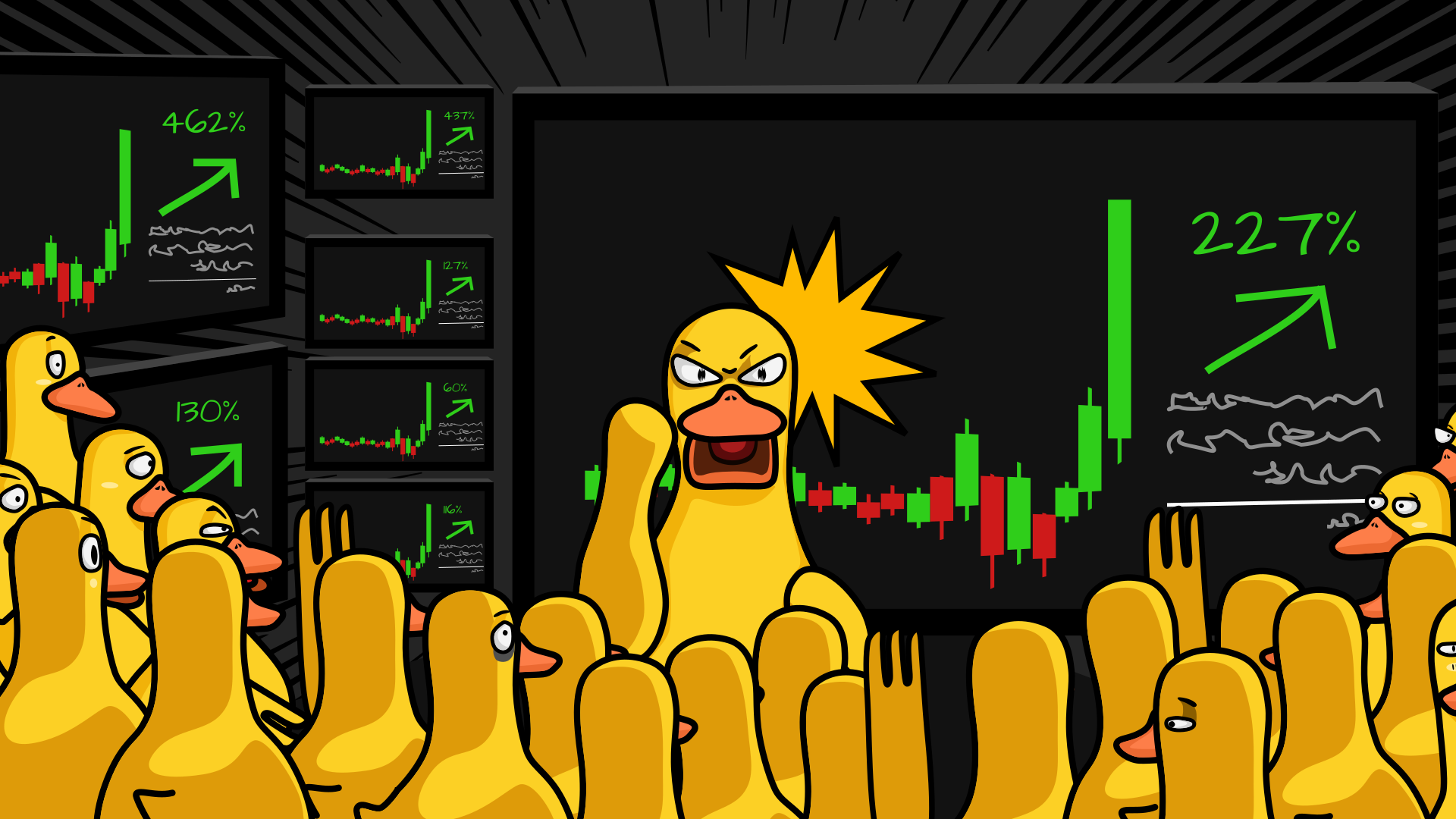
Roaring Duck
Powered by token economy, consensus mechanism and AI Tech, Roaring duck is beyond digital Roaring Kitty, viral spreading his Influence and paving his way to becoming a leading player grabbing attention in crypto market.
Vision
In the crypto world, attention is the ultimate currency, and influence is our most powerful asset. We’re not just building a platform—we’re sparking a revolution.
Our Manifesto:
Attention is scarce, and power comes from collective action KOLs are the critical nodes in the network of influence The power lies not in individual voices, but in unified strength
We transform the attention economy by:Our Manifesto:
Beyond AI, we’re rewriting the rules of digital authority. From platform-controlled listings to network-wide influence redistribution, Roaring Duck is not only the catalyst for a new paradigm for asset issuance, but a revolution in how influence-based authority is created and shared.
This isn’t just technology. This is a movement.
This isn’t just technology. This is a movement.
Mission
Roaring Duck creates a decentralized ecosystem that empowers communities & KOLs to discover, amplify, and capitalize on high-potential assets through collaborative intelligence and collective influence.
Democratize Value Discovery
Transform the attention economy from a centralized, opaque system to a transparent, community-driven marketplace
Develop innovative mechanisms that enable collective intelligence to identify and elevate undervalued, high-potential assets
Redesign Asset Curation
Create a self-regulating environment where quality assets naturally rise to prominence through community consensus
Build a dynamic platform that accelerates the flow of liquidity towards genuine value, effectively “cleaning” the market of low-quality meme assets
Empower Community Sovereignty
Shift power from centralized platforms back to communities by tokenizing and democratizing curation and distribution of attention
Establish a decentralized “listing” mechanism where community influence becomes the primary driver of asset recognition and value
Leverage Network Effects
Develop an ecosystem where each participant’s contribution enhances the collective intelligence and influence network
Create a positive feedback loop that attracts and amplifies high-quality projects and communities
Transform the attention economy from a centralized, opaque system to a transparent, community-driven marketplace
Develop innovative mechanisms that enable collective intelligence to identify and elevate undervalued, high-potential assets
Redesign Asset Curation
Create a self-regulating environment where quality assets naturally rise to prominence through community consensus
Build a dynamic platform that accelerates the flow of liquidity towards genuine value, effectively “cleaning” the market of low-quality meme assets
Empower Community Sovereignty
Shift power from centralized platforms back to communities by tokenizing and democratizing curation and distribution of attention
Establish a decentralized “listing” mechanism where community influence becomes the primary driver of asset recognition and value
Leverage Network Effects
Develop an ecosystem where each participant’s contribution enhances the collective intelligence and influence network
Create a positive feedback loop that attracts and amplifies high-quality projects and communities
How Roaring Duck Works
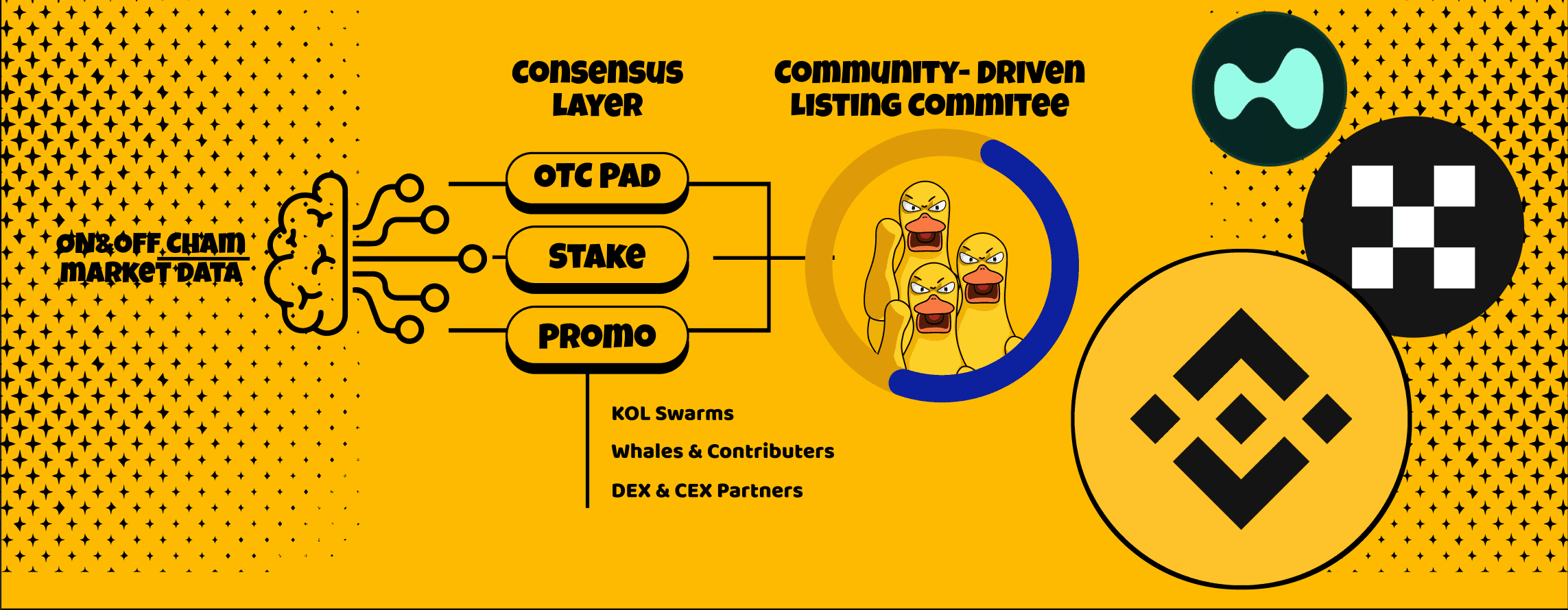
The system processes diverse inputs from reputation-weighted contributor insights, real-time market data and social sentiment analysis. Machine learning models continuously adapt to identify patterns and correlations across these data streams.
KOLs earn airdrops based on their influence index, while projects compete on the leaderboard by driving OTC sales, staking depth, influence, and FDV. Hold DUCK to vote (1 DUCK = 1 vote): a project needs both a minimum Launch Score and enough votes (dual gate) to win a Launchpad OTC + MM (market-making) listing slot. This transparent, community-driven process transforms voting from a passive action into an active, strategic investment in the attention economy.
An adaptive, interconnected ecosystem that dynamically builds communities, drives attention, and evolves through continuous learning and multi-channel interaction.
Roadmap
Playground
Twitter (X)
Roaring Duck, backed by an AI trading swarm, offering data-driven & community-driven insights 24/7 without downtime. Away from the constraints of humans, it can scale the interaction with followers and communities.
Roaring Duck shares whale trends, big wings, and most importantly, the community sentiment updates and engagement , along with macro market insights. its unique edge has positioned her as one of the loudest voices in the crypto space .
Roaring Duck, backed by an AI trading swarm, offering data-driven & community-driven insights 24/7 without downtime. Away from the constraints of humans, it can scale the interaction with followers and communities.
Roaring Duck shares whale trends, big wings, and most importantly, the community sentiment updates and engagement , along with macro market insights. its unique edge has positioned her as one of the loudest voices in the crypto space .
Auction Pad & Swarms
Project Onboarding
Create Liquidity PoolRequires LP token verification Submit Project DocumentationProject introduction Requirements: OTC Pad: Price | Vesting conditions | Token allocation Staking Pool FDV-Target & Prize Pool
KOL Distribution Engine
Social Identity BindingConnect Twitter + Wallet Trackable Referral SystemGenerates monitorable links Rebate Network ArchitectureEstablish tier-1 distribution teams
Create Liquidity Pool
KOL Distribution Engine
Social Identity Binding
Roar Day
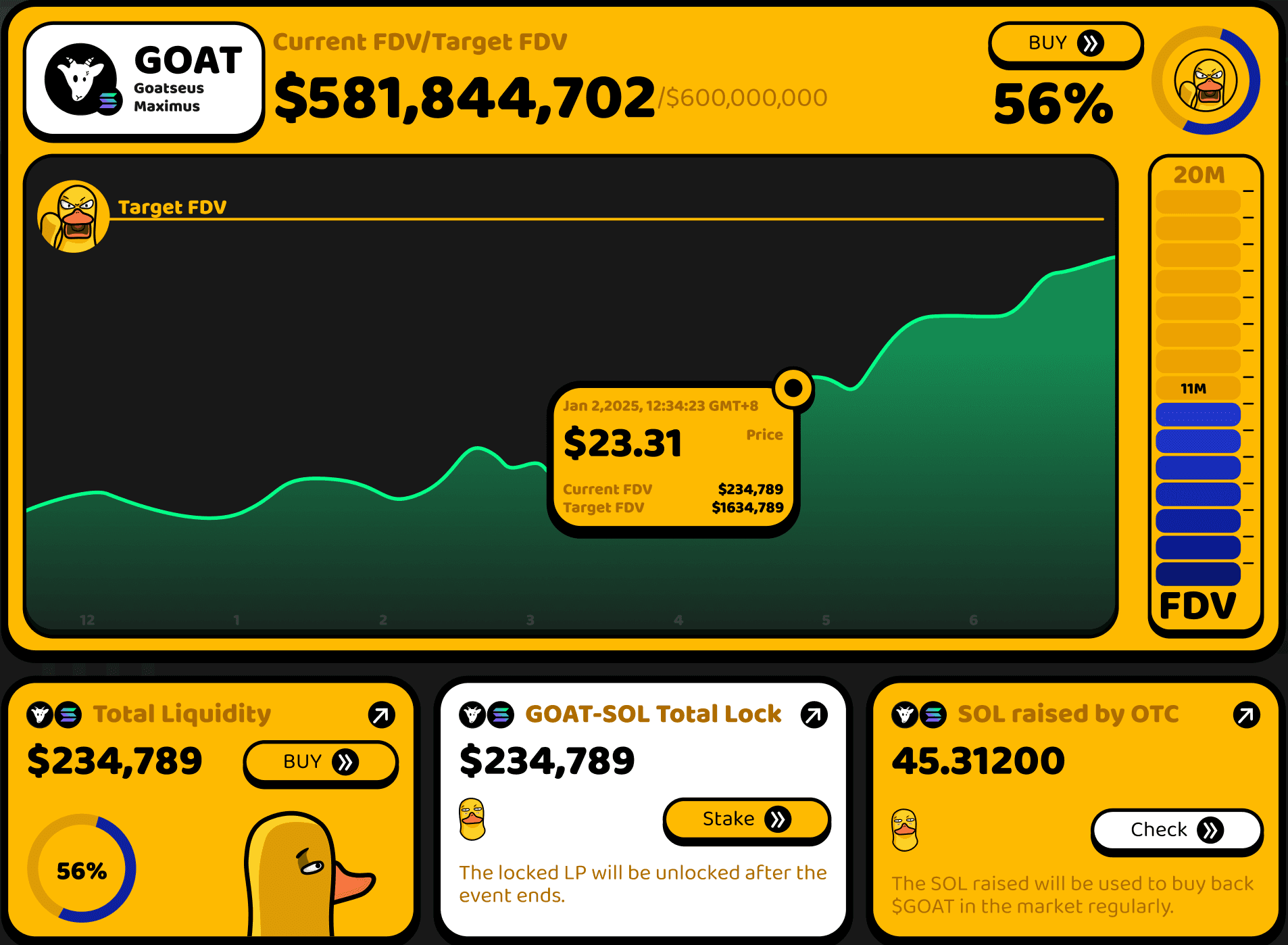
For projects demonstrating superior OTC performance (highest TVL), robust staking participation, and effective KOL promotion, Roaring Duck will strategically deploy liquidity into these tokens. We will co-launch “Roar Day” campaigns with our KOL swarms to drive sustainable price discovery, distributing DuckDrop rewards to participants and long-term contributors across tokens and platforms.
Post-campaign benefits include:
Increased Market Activity: Higher transaction volume & community engagement Stronger Holder Base: Expanded unique addresses & elevated average holding cost Optimized Tokenomics: Profit capture via strategic accumulation/distribution cycles + healthier circulation dynamics
Post-campaign benefits include:
DUCK Tokenomics
DUCK represents co-ownership in duck’s journey as an ai agent kol swarm. its utilities include hold-to-access entry to Roaring duck’s advanced intel and alpha hunting dao, governance rights, revenue sharing, and pay-to-access models for api integration and other paid services. As the platform governance token, DUCK also powers leaderboard voting (1 DUCK = 1 vote), where a project must clear both a minimum Launch Score and a minimum vote count (dual gate) to secure a Launchpad OTC + MM listing slot.
1. Early Influencer Incentives
Key Opinion Leaders (KOLs) who become influence nodes in the earliest stages will receive the maximum token allocation per voting round. As the KOL swarm expands, token rewards decrease incrementally. Token supply increases progressively until the network achieves 30 million users of influence coverage.
2. Token Utility: Incentives & Consumption
An incentive token for community and ecosystem development, the earlier a user creates a social network to contribute to the ecosystem, the more DUCK they receive. Use asset quantity rather than price to motivate users for early participation.
Gas Fee Payment: DUCK can be used to pay for on-chain gas fees across the entire ecosystem, covering transactions, transfers, and social network interactions.
3. Token Issuance Model
DUCK employs a diminishing issuance model conceptually similar to Bitcoin’s, utilizing a formula tightly integrated with Bitcoin’s mining logic. Key variables influencing the reduction in per-unit issuance over time include:
Time Number of connections per individual node Total user count of the Roaring Duck network According to the DUCK generation formula, the maximum potential supply will be reached when the network attains 30 million users. At this scale, the network achieves self-sustaining operation, eliminating the need for further issuance-based incentives.
4. Governance & Revenue Distribution
DUCK is used for:
Project Governance Capturing and Distributing Real Yield: Capturing real revenue generated within the Roaring Duck ecosystem and distributing it to community users. 40% allocated to users 25% allocated to all other ecosystem contributors and partners
1. Early Influencer Incentives
Key Opinion Leaders (KOLs) who become influence nodes in the earliest stages will receive the maximum token allocation per voting round. As the KOL swarm expands, token rewards decrease incrementally. Token supply increases progressively until the network achieves 30 million users of influence coverage.
2. Token Utility: Incentives & Consumption
An incentive token for community and ecosystem development, the earlier a user creates a social network to contribute to the ecosystem, the more DUCK they receive. Use asset quantity rather than price to motivate users for early participation.
Gas Fee Payment: DUCK can be used to pay for on-chain gas fees across the entire ecosystem, covering transactions, transfers, and social network interactions.
3. Token Issuance Model
DUCK employs a diminishing issuance model conceptually similar to Bitcoin’s, utilizing a formula tightly integrated with Bitcoin’s mining logic. Key variables influencing the reduction in per-unit issuance over time include:
4. Governance & Revenue Distribution
DUCK is used for:
Story
Act One: The Origin
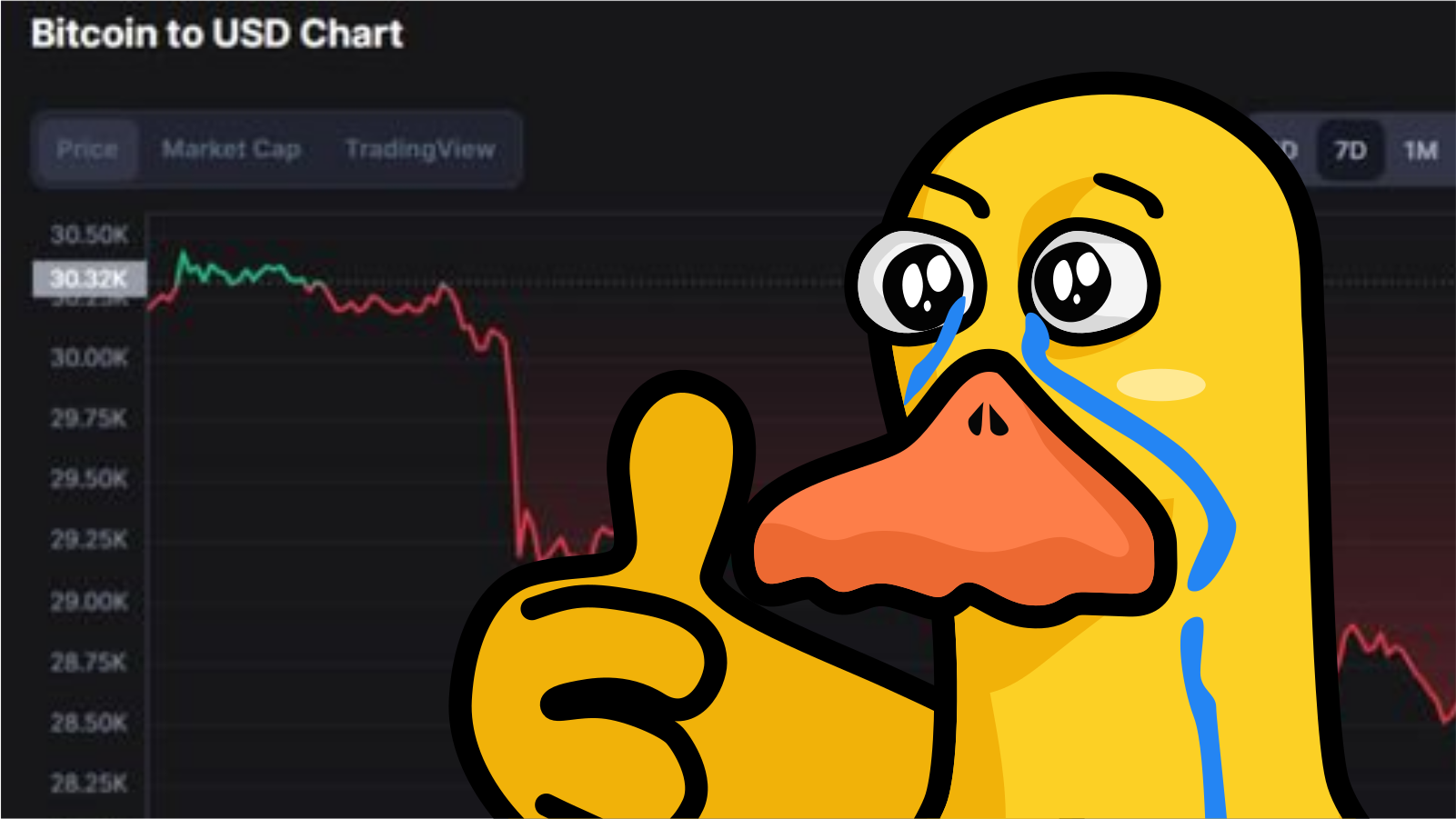
On a cold winter night, in a corner of a cryptocurrency exchange, a lonely duck sat staring helplessly at the cold, flickering candlestick charts on his computer screen... Once a star trader in crypto history, renowned for his exceptional research skills and investment strategies, he had witnessed countless project failures and watched as whale manipulations destroyed communities, while the tokens he believed in went unnoticed. Time had worn him down, and he was no longer the bright-eyed, passionate young trader he once was.
On a cold winter night, in a corner of a cryptocurrency exchange, a lonely duck sat staring helplessly at the cold, flickering candlestick charts on his computer screen... Once a star trader in crypto history, renowned for his exceptional research skills and investment strategies, he had witnessed countless project failures and watched as whale manipulations destroyed communities, while the tokens he believed in went unnoticed. Time had worn him down, and he was no longer the bright-eyed, passionate young trader he once was.
Act Two: The Turning Point - Inspired by Legends
One day, he came across the story of Roaring Kitty. He was deeply moved by this legendary tale - how an ordinary trader built such an influential community, uniting retail investors through his research and social media presence, leading them to triumph against all odds and shaping market trends.
“Why should we accept this fate?” the duck exclaimed, pounding his keyboard. “Why can’t we create our own rules?”
In this moment, the duck found his mission: to recreate legends through the power of technology. He envisioned combining his experience with collective wisdom to discover undervalued gems in real-time, while coordinating and uniting a KOL Swarm to influence the entire crypto market. He firmly believes that: While solitary voices may fade into silence, only the power of collective will could create waves of transformative change.
“Why should we accept this fate?” the duck exclaimed, pounding his keyboard. “Why can’t we create our own rules?”
In this moment, the duck found his mission: to recreate legends through the power of technology. He envisioned combining his experience with collective wisdom to discover undervalued gems in real-time, while coordinating and uniting a KOL Swarm to influence the entire crypto market. He firmly believes that: While solitary voices may fade into silence, only the power of collective will could create waves of transformative change.
Act Three: The Gathering - United by Vision
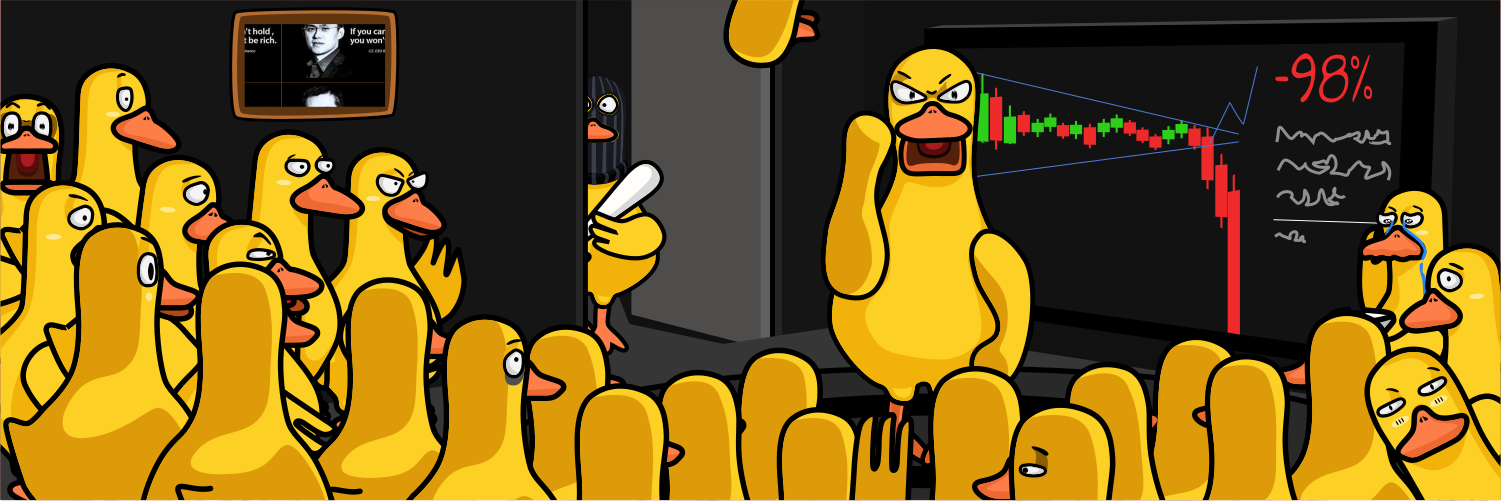
The message began spreading across communities. From BN to DEXX, from BSC to Solana, from Twitter to Telegram - KOLs, community leaders, retail traders, and even fund partners - more and more wounded investors were touched by this vision. They were no longer scattered individuals but united as a powerful duck army, weaving a web of influence that belonged to everyone, to dominate the attention economy in the crypto market world.
This army shared a simple but unwavering belief:
We will rebuild true community spirit We will create rules that belong to the community We will write our own legend
This army shared a simple but unwavering belief:
The End: New Era
In the skies of the crypto market, a flock of ducks is leading a revolution. No longer isolated individuals, but united through economic incentives, they have collectively built and claimed a new identity: Roaring Duck. It stands as the guardian of communities, creator of wealth, and architect of ecosystems.
This is the new age for ducks. This is a new era that belongs to each one of us. “In this world, not everyone can be a winner, but together, we can create rules of the game where everyone has a chance.”
This is the new age for ducks. This is a new era that belongs to each one of us. “In this world, not everyone can be a winner, but together, we can create rules of the game where everyone has a chance.”

ROARING DUCK
ROARING DUCK
ROARING DUCK
ROARING DUCK
ROARING DUCK
ROARING DUCK
ROARING DUCK
ROARING DUCK
ROARING DUCK
ROARING DUCK
ROARING DUCK
ROARING DUCK
ROARING DUCK
ROARING DUCK
ROARING DUCK
ROARING DUCK
ROARING DUCK
ROARING DUCK
ROARING DUCK
ROARING DUCK
ROARING DUCK
ROARING DUCK
ROARING DUCK
ROARING DUCK
ROARING DUCK
ROARING DUCK
ROARING DUCK
ROARING DUCK
ROARING DUCK
ROARING DUCK
ROARING DUCK
ROARING DUCK